



Your channel viewers will see links here, including "subscribe" and "add as friend".
Profile
Name
Alien Frog King
Description
niche movement training and fitness
small space speed training, fast motor unit recruitment, gymnastics rings, ropes, bridge rotation and qdr flows, footwork drills. Martial art flavoured & longevity and performance focus
I am not advanced in anything or claim to be competent enough to teach, I share with online friends and track my progress with YouTube
Subscribers
807
Subscriptions
Recent Activity
 |
Alien Frog King
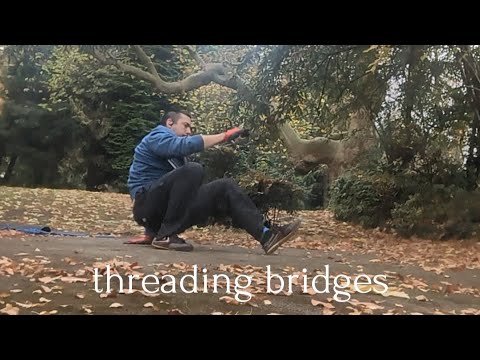
A few months back I had an email from Phillip Beach ( Contractile Field (CF) model), I didn't understand what he meant by using the eyes during bridge rotation regarding decussation of the sub occipital area.
Unfortunately, he didn't email back to my further enquiry, but Ai seems to have helped, and I'll post the info here in case someone else finds the explanation useful - his book is very theoretical and doesn't have any practical advice regarding bridges, so this is a bit like filling in a gap:
the eyes are not just for seeing; they are "nodal sense organs" that act as the master switch for the Helical CF (twisting/rotation) and the Dorsal CF (back extension).
Integrating eye movements into your bridge allows you to "re-wire" the connection between your visual system and the deep stability muscles of your spine.
The "How": Implementing the Gaze
When you are at the top of your bridge, try these three variations:
Fixed Gaze Rotation: Fix your eyes on a single point on the ceiling. While keeping your eyes "locked" to that spot, slowly rotate your torso or reach one arm over. This forces the neck to stay stable while the body moves around it.
Leading with the Eyes: Move your eyes first to a point on the floor behind you (as if trying to see where your hands would land). Allow the head and then the spine to follow that visual "lead."
Cross-Lateral Tracking: While bridging, move your eyes slowly from the far left to the far right without moving your head. This activates the "decussation" pathways he mentioned, which helps reset the tone of the suboccipital muscles at the base of your skull.
The "Why": The Eye-Neck Hardwiring
Proprioceptive Hub: The suboccipital muscles have more nerve receptors per gram than almost any other muscle. They are designed to respond instantly to eye movement to keep your head level.
Decussation (The "X" Factor): Because nerve pathways cross, looking to the right actually "primes" the muscles on the left side of your spine. Using eye movements in a bridge ensures that both sides of your "crossed" helical fields are firing in balance.
Lowering "Threat": If your eyes and neck are tense, your brain perceives a "threat" and stiffens the rest of your back. Fluid eye movements tell the brain the environment is safe, allowing the spine to "un-lock" and flow.
The "When" and "Where"
When: Use these during the static hold of a bridge to refine your posture, or at the initiation of a twisting bridge to guide the movement.
Where: Focus your gaze on "nodes"—specific points in your environment. Looking toward your feet helps "close" the front of the body, while looking "up and back" (toward the top of your head) deepens the dorsal contraction.
If you find a "blind spot" or a direction where your eyes jump instead of gliding, spend extra time there. That "jump" often correlates to a "stuck" spot in your spinal movement.
The "Nose Link" in the Bridge
Phillip Beach views the nose as the primary sensory node for our front-to-back "open and close" movements. This is deeply rooted in evolutionary biology—primitive creatures lead with their nose (smell/snout) to navigate forward or retract away.
In a bridge push-up, your nose alignment acts as the "rudder" for your spine:
Linear Tracking: For a "clean" dorsal contraction (the arch), keeping your nose aligned with your midline ensures that the left and right sides of your back are firing equally.
The "Reach" of the Snout: If you lead the bridge by reaching your nose back toward the floor, it naturally "invites" the rest of the spine into a deeper extension.
Neutralizing the Neck: Many people "kink" their neck by throwing their chin up. Beach would suggest focusing on where your nose is pointing to ensure the extension is distributed through the whole spine rather than just "hinging" at the neck.
How to use this "Link"
Next time you are doing a set of bridge push-ups, try these two "nose-focused" cues:
Symmetrical Opening: As you push up, imagine your nose is moving in a perfectly straight line away from your sternum. This keeps the D/V Field balanced.
The Sensory Switch: If you feel "stuck" at the top of the bridge, move your eyes to one side. You will likely feel an immediate urge for your nose to follow and your body to start rotating. This is you "switching" from the Dorsal Field to the Helical Field.
The Contrast
Nose focus: Best for the power and symmetry of the push-up (D/V Field).
Eye focus: Best for the flow and rotation Beach mentioned in his email (Helical Field).
It's a subtle but powerful way to "tune" the movement
|
|
|
Alien Frog King
I thought I'd lost this book but found it covered in cobwebs down the side of a shelf, its got interesting theories on the development of human anatomy and movement patterns
    |
|
Friends
Channel Comments

|
reverendterminator
(1 year ago)
i got alot more power on pullups then chin ups and neutral grip...probably cause i can use more of the back system.
|
|
|
reverendterminator
(1 year ago)
they should have a rope/rings like this in clothes store, and say if you can hang by the rope with one hand - and put the shirt on and off, you get it for free :D and straigth to muscle ups ...
|
|
|
reverendterminator
(1 year ago)
shirt on shirt off!! good footage bro
|

|
DavidWhitten
(1 year ago)
Barefoot, Gym , and now the !!! Good to see you are still well and doing the training you enjoy. And without a doubt the hanging and dressing is very impressive!
|

|
DuncanWalshover40workouts
(1 year ago (edited))
That is a great challenge! Did you practice a bit before, not hanging, just using one hand? I would imagine you have to be quite organised with how you put them all on? Total hang time was around 2 1/2 minutes? More difficult of course when a lot of that is one arm!
|

|
timemanagementisinvesting
(1 year ago)
To be in that brain 🏼🏼
|
|
|
reverendterminator
(1 year ago)
Would it be possible for you to - move to Cornwall? or is housing prices high there?
|

|
shark_fitness
(1 year ago)
i posted the link here to the study, but it might be deleted.
|

|
SimonTrageser
(1 year ago)
This is some serious grip strength right there brother!!
|

|
BurpeeclubRotterdam
(10 months ago)
That's a lot of grip streng. Well done!
|

|
smithysjorney
(1 year ago)
That looks insane
|

|
creativetraininghacks
(1 year ago)
Super strong enduring grip 🏽I find it particularly hard to reach the other ring with the other hand after hanging on one arm for a while. Tried to do it on just one ring yesterday with just a T-shirt, but had no chance.
|

|
John-Imperial
(1 year ago)
Awesome challenge afk! And that max pull ups after was icing on top
|

|
projectburpees
(1 year ago)
New name, same game! Looking strong!
|

|
AlekMarkes
(1 year ago)
Но если бы было холоднее, оделся бы быстрее
|
|
|
reverendterminator
(1 year ago)
but bro, even if a person got the strength to dead hang with one hand, it is still difficult to put on and off a shirt, with just one hand!! And you are doing it outside the Matrix also - just like NEO
|

|
TrainingEverydayUntilIDie
(8 months ago)
Beutiful tree.
|
Add comment